



Citation Examples: Chicago
It is recommended to use Citation Management Software such as Zotero to store your sources and generate bibliographies.
Chicago style refers to the Chicago Manual of Style, 17th Edition (CMOS 17).
Note: The 18th edition of the Chicago Manual of Style (CMOS 18) was published in September 2024 and introduces some changes, particularly to the handling of electronic sources and AI-generated content. The examples on this page follow CMOS 17, which remains widely used. Please confirm with your instructor which edition is required for your programme.
Citing sources in Chicago Author-Date style consists of two parts:
- An in-text citation (a brief parenthetical reference within the body of your text)
- A bibliography entry (the full source details, listed alphabetically at the end of your paper)
Every in-text citation must correspond to a full entry in your bibliography, and every bibliography entry should be cited at least once in your text. Together, the two parts allow the reader to trace any claim back to its original source.
DOIs preferred over URLs: When citing electronic sources, always use a DOI (Digital Object Identifier) if one is available, as DOIs are permanent and stable. Only use a URL if no DOI exists. A DOI is formatted as a full link: https://doi.org/10.xxxx/xxxxx.
In-text Citations (Author-Date Format)
Basic Format
(Author Year, Page Number)
Detailed Examples and Cases
Two or More Authors with the Same Last Name
When the reference list has works by authors with the same last name, include their first initial in the in-text citation.
Institutional development in Germany followed a path-dependent trajectory shaped by vocational training systems (K. Thelen 2004).
Multiple Works by the Same Author in the Same Year
If an author has published multiple works in the same year, alphabetise the titles in the reference list and then add a, b, c, etc. to the year.
(Sheringham 2010a)
(Sheringham 2010b)
Sheringham's first study focused on archival practices in urban spaces (Sheringham 2010a), while his later work expanded the analysis to include suburban landscapes (Sheringham 2010b).
Multiple Citations
To cite more than one reference in a single in-text citation, separate the references by semicolons. If the works are by the same author, use just the year and separate with a comma. See CMOS 15.30 for details.
(Thelen 2004; Gourevitch and Shinn 2005)
(Thelen 2004, 2006; Gourevitch and Shinn 2005)
Several scholars have argued that corporate governance structures are shaped by national institutional frameworks (Thelen 2004; Gourevitch and Shinn 2005).
Figures (Artwork/Images)
Images should appear shortly after you mention them in your paper, should be numbered (Figure 1, Figure 2, etc.), and should appear in the List of Figures of your research.
Chicago style also states that "a brief statement of the source of an illustration, known as a credit line, is usually appropriate" (CMOS 3.29: Sources and permissions). Chicago style does not prescribe the exact format of this statement. The style does not require that images included in a paper be listed in the bibliography.
If you wish to include an image in your paper, BI requires at least the following information:
- Author or creator's name
- Title, or brief description if no title exists
- Year (if available)
- Format (plan, photo, diagram, oil on canvas, etc.), if not apparent
- Origin (publication title, website, etc.)
- URL (for online sources only)
- Date of access (for online sources only)
Additional data that add context, such as a caption, are encouraged.
Example
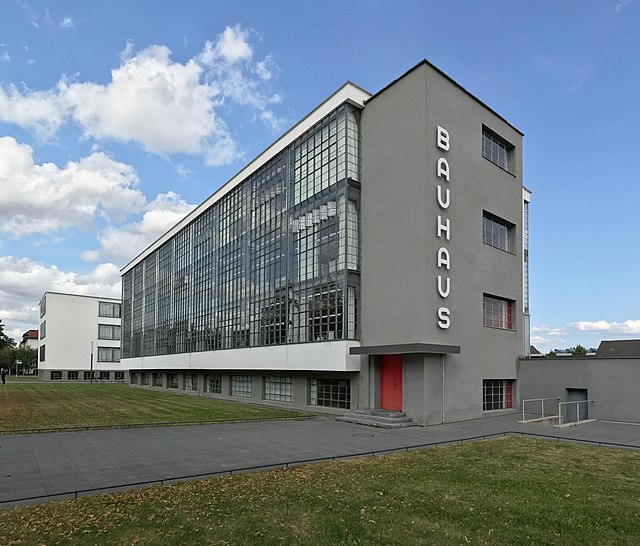

In the example above, the elements correspond to:
Bibliography / References / Works-Cited
The bibliography appears at the end of your paper and provides the full publication details for every source cited in the text. Entries are listed alphabetically by the first author's last name (or by title, ignoring articles such as "A," "The," or "An," when no author is available). The bibliography allows your reader to locate and verify each source you have used.
Formatting note: Bibliography entries use a hanging indent: the first line of each entry is flush left, and all subsequent lines are indented (typically by 1.27 cm / 0.5 in). In Microsoft Word, you can apply this via Paragraph > Special > Hanging. In Google Docs, use Format > Align & indent > Indentation options > Special indent > Hanging.
Generative Artificial Intelligence (AI)
If you decide to incorporate generative AI tools into your work, it is crucial to carefully consider how you give credit to and cite the results generated by these tools. Make sure to consult with your instructor before integrating AI into your coursework to ensure compliance with guidelines and expectations.
Note: For more information about using generative AI tools in your research, see Making the most of Generative AI (ChatGPT etc.).
Guidance on citing AI is evolving. The information below reflects the position published by the Chicago Manual of Style in 2023. CMOS 18 (published September 2024) refines this guidance further. Since many AI tools now provide shareable conversation links, the earlier advice to treat AI output like a personal communication may no longer apply in all cases. Always check the latest CMOS guidance on citing AI and confirm with your instructor.
Chicago Manual of Style, Citing Content Developed or Generated by Artificial Intelligence
In Chicago style, when citing AI-generated content, acknowledge the AI tool as the author. You can include a note or parenthetical citation without listing it in your bibliography. Mention the prompt details in the text or as a footnote, and use the date of content generation in your citation.
Format
Example (if information about the prompt has been included within the text of your paper)
Example (including information about the prompt)
Books / eBooks
Book (single author)
Author’s Last name, First name. Year of publication. Title: Subtitle. Edition. Place of publication: Publisher.
Thelen, Kathleen. 2004. How Institutions Evolve: The Political Economy of Skills in Germany. Cambridge: Cambridge University Press.
<h4 id="bkmrk-book-two-three-authors">Book (two or three authors)</h4>
<p>First author Last name, First name, and second author First name Last name. Year of publication. <em>Title: Subtitle.</em> Edition. Place of publication: Publisher.</p>
<p class="callout success">Gourevitch, Peter, and James Shinn. 2005. <em>Political Power and Corporate Control: The New Global Politics of Corporate Governance.</em> New Jersey: Princeton University Press.</p>
<h4 id="bkmrk-book-four-plus-authors">Book (four or more authors)</h4>
<p>First Author Last name, First name, remaining authors’ First name Last name. Year of publication. <em>Title: Subtitle</em>. Edition. Place of Publication: Publisher.</p>
<p class="callout success">De la Bédoyère, Camilla, Ihor Holubizky, Julia Kelly, Michael Kerrigan, James Mackay, William Matar, Tom Middlemos, Michael Robinson, and Iain Zaczek. 2006. <em>A Brief History of Art.</em> London: Flame Tree Publishing.</p>
<h4 id="bkmrk-ebooks">eBooks</h4>
<p>Author(s) Last name, First name. Year of publication. <em>Title: Subtitle</em>. Edition. Place of Publication: Publisher. DOI, URL, or database name.</p>
<p class="callout success">Beaumont, Lesley A. 2012. <em>Childhood in Ancient Athens: Iconography and Social History</em>. London: Routledge. <a href="https://ebookcentral.proquest.com/lib/ucd/detail.action?docID=1114632">https://ebookcentral.proquest.com/lib/ucd/detail.action?docID=1114632</a>.</p>
<hr>
<p class="callout info"><strong>Note:</strong> If a book is available in print and online, you must cite the version you consulted. Access dates are only included if no publication date information is available. If no place of publication is available for an eBook, write "n.p." ("no place") in its position.</p>
<p class="callout info"><strong>Note:</strong> If you access your book on an eReader or other type of platform, insert that instead of the URL (e.g., Kindle, Google Play Books, Apple Books).</p>
<p class="callout info"><strong>Note:</strong> Where page numbers are not available or change depending on the device used, CMOS 17 advises including chapter numbers or section headings instead. If a scanned version of the original book is available online, this version is preferable for citation.</p>
Book Chapters
Author(s) Last name, First name. Year of publication. “Title of Chapter.” In Book Title, edited by First name Last name, Pages. Place of publication: Publisher.
Sheringham, Michael. 2010. “Archiving.” In Restless Cities, edited by Matthew Beaumont and Gregory Dart, 10–24. London: Verso.
Journal Articles
Journal article (single author)
Author(s) Last name, First name. Year of publication. “Title of Article.” Journal Title Volume, Issue no. (month or season): Pages.
Barber, Marcus. 2024. “Global Warming and the Political Ecology of Health: Emerging Crises and Systemic Solutions.” The Australian Journal of Anthropology 21, no. 3 (Winter): 390–391.
<h4 id="bkmrk-journal-two-three-authors">Journal article (two or three authors)</h4>
<p>First Author Last name, First name, remaining authors First name Last name. Year of publication. “Title of Article.” <em>Journal Title</em> Volume, Issue no. (month or season): Pages.</p>
<p class="callout success">Morgan, Sylvia, Danny Carswell, and Lynda Lamore. 2010. “The Rise of Political Correctness in Post-War Britain.” <em>Twentieth Century Britain</em> 25, no. 3 (March): 412–416.</p>
<h4 id="bkmrk-journal-four-plus-authors">Journal article (four or more authors)</h4>
<p>First Author Last name, First name, remaining authors First name Last name. Year of publication. “Title of Article.” <em>Journal Title</em> Volume, Issue no. (month or season): Pages.</p>
<p class="callout success">Virtue, Simon, Holly Wright, Dale Diamond, and Sheila Murphy. 1943. “Was Mark Twain a Nihilist?” <em>American Literary Essays</em> 3, no. 88 (Winter): 13–27.</p>
<h4 id="bkmrk-ejournal-article">eJournal article</h4>
<p>Author(s) Last name, First name. Year of publication. “Title of Article.” <em>Journal Title</em> Volume, Issue no. (month or season): Pages. DOI or URL.</p>
<p class="callout success">Mulvin, Lynda, and Steven E. Sidebotham. 2004. “Roman Game Boards from Abu Sha'ar (Red Sea Coast, Egypt).” <em>Antiquity</em> 78, no. 301 (September): 602–617. <a href="https://doi.org/10.1017/S0003598X00113250">https://doi.org/10.1017/S0003598X00113250</a>.</p>
<hr>
<p class="callout info"><strong>Note:</strong> CMOS 17 advises including an access date only when no publication date is provided.</p>
<p class="callout info"><strong>Note:</strong> Month of publication only needs to be included where given in the source.</p>
<p class="callout info"><strong>Note:</strong> For four or more authors, list all authors in the bibliography. In a footnote, list only the first author followed by "et al." For more than ten authors, list the first seven in the bibliography followed by "et al."</p>
Theses and Dissertations
Author Last name, First name. Year. “Title of Thesis.” Type of thesis, Institution. DOI or URL.
Okonkwo, Adaeze. 2024. “Brand Storytelling and Consumer Engagement in the German Start-Up Ecosystem.” Master's thesis, Berlin International University of Applied Sciences. https://repository.berlin-international.de/items/example.
Note: The type of thesis should be specified exactly (e.g., "Bachelor's thesis," "Master's thesis," "PhD diss."). If the thesis is available in the BI Institutional Repository or another online repository, include the DOI or URL.
Reports and White Papers
Author(s) or Organisation. Year. Title of Report. Report number (if applicable). Place of publication: Publisher. DOI or URL.
Organisation for Economic Co-operation and Development. 2023. OECD SME and Entrepreneurship Outlook 2023. Paris: OECD Publishing. https://doi.org/10.1787/342b8564-en.
McKinsey & Company. 2024. The State of AI in Early 2024: Gen AI Adoption Spikes and Starts to Generate Value. https://www.mckinsey.com/capabilities/quantumblack/our-insights/the-state-of-ai.
Note: When an organisation is both the author and the publisher, it is acceptable to list the organisation as the author and omit it from the publisher position, or to list it in both positions. Be consistent throughout your bibliography.
Conference Papers and Proceedings
Author(s) Last name, First name. Year. “Title of Paper.” Paper presented at Conference Name, Location, Date. DOI or URL.
Chen, Wei, and Laura Müller. 2023. “Sustainable Materials in Modular Housing: A Comparative Analysis.” Paper presented at the International Conference on Sustainable Design, Copenhagen, September 14–16, 2023.
If the paper is published in a proceedings volume:
Author(s) Last name, First name. Year. “Title of Paper.” In Title of Proceedings, edited by First name Last name, Pages. Place of publication: Publisher. DOI or URL.
Nakamura, Yuki. 2022. “User Experience Design for Ageing Populations.” In Proceedings of the 2022 Design Research Society Conference, edited by Ri Pierce and Paul Rodgers, 312–325. London: Design Research Society. https://doi.org/10.21606/drs.2022.example.
Artworks / Images
Note: CMOS 17 states that paintings, sculptures, and photographs can normally be cited in the text with full source details. A bibliography entry is not a requirement (CMOS 14.235: Citing paintings, photographs, and sculpture).
Creator/Artist(s) Last name, First name. Title. Date of creation/completion. Medium, Dimensions (dimensions conversion). Location of work. DOI, URL, or database name.
Gloag, Isobel. The Woman with the Puppets. 1915. Oil on canvas, 64.5 × 82.5 cm (25.39 × 32.48 in). Hugh Lane Gallery, Dublin, Ireland. http://emuseum.pointblank.ie/online_catalogue/work-detail.php?objectid=619.
Webpages
Author Last name, First name. “Title of Web Page.” Website name or publishing organisation. Publication date or last modified date, year. Access date if no other date available. DOI or URL.
Hayden, Meadhbh. “My Tips for Swimming in the Irish Sea.” SpunOut.ie. February 23, 2021. https://spunout.ie/voices/advice/my-tips-swimming-irish-sea.
Note: If no author is available, the publishing organisation can be used instead. If neither is available, list the title first. Use the first significant word (ignoring articles such as "A," "The," or "An") to determine alphabetical placement in the bibliography.
Note: Only provide an access date if the date published or last modified is unavailable.
Note: The publishing organisation does not need to be included if it is the same body as the website name, title, or author.
Thanks to the following sources for providing partial inspiration and content for this page: Concordia University Chicago, Klinck Memorial Library and UCD Library, University College Dublin.