



How to Write an Outline
Overview
An outline is a structural framework for your paper. It organises your ideas, sources, and arguments before you write the first draft. Taking the time to build a thorough outline prevents writer's block, exposes gaps in your research, and ensures your final argument flows logically from start to finish.
Prerequisites
Before you attempt to write an outline, you must have:
- A clear research question or thesis statement.
- Thematically organized notes, such as a synthesis matrix.
Choosing an Outline Format
Different disciplines and learning styles benefit from different outlining methods. Choose the one that best fits your workflow.
1. The Linear Outline (Standard Alphanumeric)
This is the traditional, top-down approach. It works exceptionally well for Business Administration (FoB) reports and empirical research papers. You use a combination of numbers and letters to establish a hierarchy of ideas.
- I. Introduction
- A. Hook or context
- B. Research question and thesis statement
- II. First Main Theme (e.g., EU Supply Chain Regulations)
- A. Topic sentence introducing the theme
- B. Evidence from Source 1 (Author, Year)
- C. Evidence from Source 2 (Author, Year)
- D. Analysis of how this evidence supports the thesis
- III. Second Main Theme...
2. The Visual Outline (Mind Mapping)
Some students think spatially rather than linearly. A visual outline or mind map allows you to group concepts on a blank canvas before forcing them into a linear sequence.
- Write your main thesis in the centre of the page.
- Draw branches outward for your main themes or case studies.
- Attach specific pieces of evidence, precedent images, or author quotes to each branch.
- Once the map is complete, assign a number to each branch to dictate the final reading order.
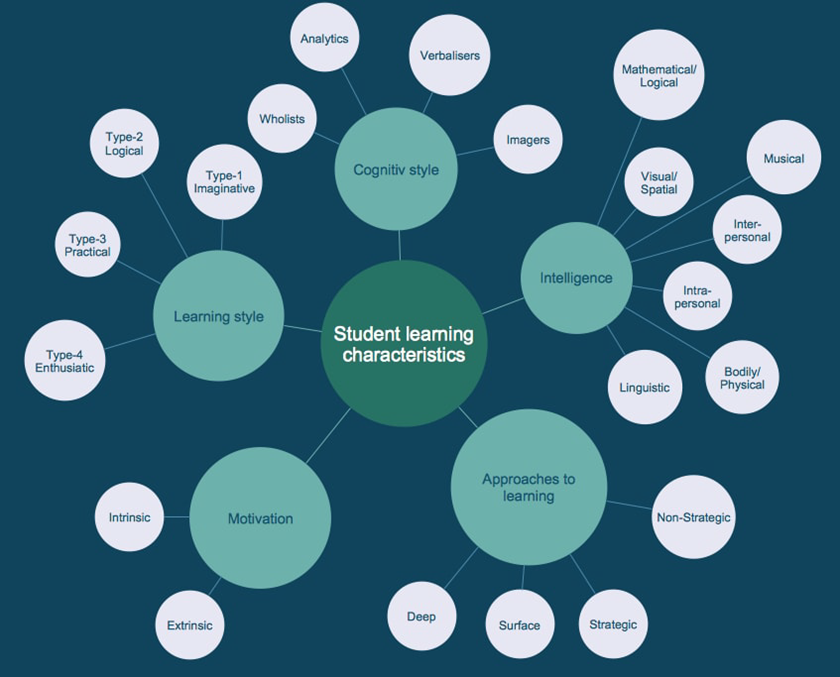
"Spray diagram Student learning characteristics" by CS Odessa is licensed under CC BY 4.0.
The Standard Academic Structure
Regardless of whether you outline visually or linearly, most academic papers require three core components:
The Introduction
Your introduction should account for roughly ten percent of your total word count. It must provide the background context, introduce the specific problem you are investigating, and end with a clear thesis statement. The thesis statement is the direct answer to your research question.
The Body Paragraphs
This is the core of your paper. Do not organise your body paragraphs by author (e.g., "Smith says X. Jones says Y."). Instead, organise them by theme or concept.
Plan each body paragraph using the Topic-Evidence-Analysis structure:
- Topic Sentence: State the main idea of the paragraph clearly.
- Evidence: Introduce your paraphrased sources, data, or precedent analyses.
- Analysis: Explain exactly how this evidence proves your point. Do not leave the reader to guess why the evidence matters.
The Conclusion
The conclusion should also account for roughly ten percent of your paper. It must restate your thesis in a new way, summarise the main findings from your body paragraphs, and explain the broader implications of your research. Never introduce new evidence or new sources in a conclusion.
Tip: Write the introduction last. Many students get stuck trying to write the perfect introduction. Outline the whole paper, draft your body paragraphs first, and then write the introduction once you know exactly what your paper actually says.
Reverse Outlining: A Tool for Editing
If you have already written a messy first draft and feel like the argument is completely lost, use a technique called "reverse outlining."
- Read your draft and highlight the main point of every single paragraph.
- Write those main points in a numbered list on a separate piece of paper.
- Read the list.
Does the list make logical sense? Are there leaps in logic; are ideas repeated in paragraphs three and seven; does a paragraph lack a clear main point? Rearrange or delete the paragraphs based on this reverse outline to instantly fix the structure of your paper.
Using Generative AI for Outlining
Generative AI tools are excellent structural assistants, provided you supply the ideas.
Example Prompt:
"I am writing a BA thesis on sustainable materials in interior design. My main themes are cost, durability, and aesthetic flexibility. My thesis statement is [insert statement]. Suggest a logical, highly detailed structural outline for a thirty-page academic paper based on these themes."
Academic Integrity: Do not ask an AI to write the content of the outline for you. You must provide the themes, the thesis statement, and the evidence. The AI should only be used to suggest the structural sequence. Review the library's guide on Making the most of Generative AI.