Making the most of Generative AI (ChatGPT etc.)
Using Generative AI in Your Academic Work
Generative AI tools such as ChatGPT, Microsoft Copilot, Google Gemini, and Claude can assist with many parts of the research and writing process. They can help you brainstorm, draft, refine prompts, and structure search queries. They can also produce convincing but inaccurate content, fabricate sources, and reflect biases present in their training data.
This guide helps you use these tools critically and responsibly. It covers:
- what generative AI can and cannot do reliably
- how to write effective prompts
- how to use AI to assist with database searching
- how to cite AI-generated content
- what risks to watch for
Before you use any AI tool in your coursework, check your course or assignment guidelines. Policies vary by instructor, department, and faculty. If the policy is not stated, ask.
What generative AI does and does not do
Generative AI tools produce text (and sometimes images or code) by drawing on patterns learned during training on large datasets. How they handle information at the point of use varies by tool and by how you access it.
Some tools work from training data alone. These have a knowledge cutoff: they cannot access recent publications, current events, or library resources. Their outputs reflect what was in their training data, nothing more.
Other tools can retrieve external content before generating a response, a technique often called retrieval-augmented generation (RAG). Tools such as Microsoft Copilot, Google Gemini, and certain modes of ChatGPT can search the web or draw on connected sources. Some research-oriented tools (Perplexity, Elicit, Scite) are designed specifically to retrieve and summarize scholarly content.
Retrieval capability does not make a tool reliable. Even tools with web access can:
- misrepresent, misquote, or selectively paraphrase the sources they retrieve
- generate citations to sources that look real but are wrong in detail or do not exist
- present a confident synthesis that misses important contrary evidence
- reflect biases present in whatever sources they surface or were trained on
In practice, you should not assume that because a tool "searched the web" its output is accurate or that its citations are correct. Verify any source an AI tool mentions before citing it, regardless of which tool you used.
Other risks apply across most current tools:
- Bias: AI outputs reflect assumptions and gaps in training data. Be alert to skewed perspectives or missing viewpoints.
- Privacy: Many tools may use your inputs to improve future models. Do not enter personal data, confidential information, or unpublished research unless you have confirmed the tool's data handling policy.
- Academic integrity: Undisclosed AI use may violate institutional policies, regardless of which tool you used or how.
If you are unsure how a specific tool handles data or retrieval, check its documentation or ask a librarian.
Citation and Attribution
IfCitation youpractices decide to incorporatefor generative AI toolsare intostill evolving. Each major style has issued guidance, but all note that their recommendations may change. Always check your assignments,assignment academic projects, or any written work you plan to publish, it's crucial to carefully consider how you give credit torequirements and cite the results generated by these tools in your content. Make sure to consult with your instructor beforeif integratingyou are unsure whether and how to disclose AI intouse.
The general principle across styles is: if you use AI-generated content in your courseworkwork, disclose it. This applies to ensurequoted complianceor withparaphrased guidelinestext, images, and expectations.data.
Citing Generative AI: APA
Citing Generative AI: Chicago
Writing Prompts
Expand
Crafting effective prompts for a Generative AI tool is crucial for obtaining high-quality outputs. This guide provides a concise overview and tips to enhance your prompts:
Be Specific:
Generic prompts yield generic results. Specify the type, genre, audience, length, and tone for better outcomes.
Create a visually engaging poster promoting a sustainable design exhibition for a design-savvy audience. Keep it concise and modern.
Draft a concise business proposal outlining key strategies for a sustainable product launch in the current market. Target audience: investors and industry professionals.
"Act as if..." Approach:
Request the AI to assume a certain role, process, or object. This provides context and refines responses, e.g., "Act as if you are my personal trainer" when seeking recipe suggestions.
Act as if you are a design consultant. Provide creative suggestions for enhancing user experience in a mobile app focusing on simplicity and aesthetics.
Act as if you are a marketing strategist. Develop a marketing plan for a new business venture, considering target demographics and competition.
Specify Output Format:
Clearly state the desired output format, such as code, stories, reports, etc. Use phrases like "Present this in the form of..." or "Create a [output format] about/that contains..."
Design an infographic illustrating the evolution of graphic design trends in the last decade. Present this in the form of a visually appealing and informative graphic.
Compose a market analysis report on emerging e-commerce trends. Present this in the form of a concise and visually appealing slide deck for a business presentation.
Use "Do" and "Don't":
Save time and improve results by specifying preferences. For instance, "Create a recipe that includes tomatoes, chicken, and carbs, but exclude chili peppers and wheat-containing ingredients."
Develop a logo for a startup specializing in sustainable packaging solutions. Do incorporate eco-friendly elements and vibrant colors. Don't use overly complex designs.
Draft a proposal for a business event sponsorship. Do highlight the potential benefits for sponsors. Don't include excessive jargon or technical details.
Provide Examples:
Offer a sample sentence or paragraph for the AI to reference, avoiding copyrighted material. This helps shape the desired output.
Provide a description of a modern furniture design studio. For example, discuss the studio's philosophy, materials used, and signature design elements.
Describe a successful case study of a business implementing sustainable practices. For example, highlight the specific strategies adopted and the resulting positive impact on the company's image and profitability.
Consider Tone and Audience:
Specify the audience and desired tone. For example, "Give me ideas for a funny and heartwarming best man's speech suitable for a family audience."
Generate ideas for a creative pitch introducing a new design tool to fellow design students. Ensure the tone is inspiring and resonates with the enthusiasm of budding designers.
Develop content for a promotional video targeting potential investors in a tech startup. Ensure the tone is professional, highlighting the innovation and market potential of the product.
Build on Previous Prompts:
Start with a basic question and refine it over time. Adjust wording, tone, or add more context to guide the AI toward the desired output.
What are the key elements to consider in designing an interactive and user-friendly website? Build on this by providing examples relevant to design students' projects.
Begin with a basic outline for a business plan. Now, add more details about market analysis, financial projections, and potential challenges faced by startups in the current economic landscape.
Correct Mistakes and Give Feedback:
Treat the AI like a colleague, providing feedback on useful parts and areas for improvement. Correct any mistakes to enhance future responses.
The design concept is great, but it needs more emphasis on sustainability. Could you provide alternative color schemes and materials that align with eco-friendly principles?
The market analysis is insightful. However, it lacks information on potential risks. Please incorporate a section discussing potential challenges and mitigation strategies.
Ask for Prompt Creation Assistance:
If unsure how to formulate a prompt, ask the AI for help in creating one. Seek guidance by asking, "What should I ask you to help me write a blog post about AI?"
I'm brainstorming ideas for a design blog post. What prompt should I use to generate content about the impact of minimalist design on user experience?
I need to create a persuasive pitch for a business idea. How can I structure a prompt to gather information on effective strategies for presenting market potential and profitability?
Inquire about Additional Needs:
Conclude prompts by asking, "Tell me what else you need to do this" to fill in any gaps and enhance the AI's ability to generate better outputs.
I want to design a portfolio showcasing my best work. Tell me what else you need to generate prompts that will guide me in creating a visually appealing and impactful portfolio.
I'm preparing a business report on the future of e-commerce. Tell me what additional details or data you need to generate prompts that will help me gather comprehensive insights for the report.
Enhancing Search Queries with AI
Expand
Constructing advanced search queries can be difficult, even for advanced researchers. LuckilyResearch generativedatabases AI,use givenstructured thequery rightsyntax: promptBoolean operators (AND, OR, NOT), wildcards, and phrase searching. Constructing complex queries takes practice. Generative AI can help constructyou complexbuild searchan queriesinitial query structure based on ayour research question.
Prompt:
Given the research question below, construct a search query to be used in a research database that uses synonyms and employs nesting, booleans (AND, OR, NOT) and wildcards (*):"How does critical design contribute to the reimagining of urban spaces, specifically focusing on its impact on community engagement, sustainability, and the overall user experience in the architectural design process?"
Response:
("critical design" OR "speculative design" OR "design fiction")
ANDAND
("urban spaces" OR "city planning" OR "urban development")ANDAND
("community engagement" OR "public participation" OR "stakeholder involvement")ANDAND
("sustainability" OR "environmental impact" OR "ecological design")ANDAND
("user experience" OR "human-centered design" OR "occupant satisfaction")ANDAND
("architectural design process" OR "built environment design" OR "architectural innovation")
Important: Always test AI-generated search queries in the actual database and adjust them. Different databases use different syntax, and the AI does not know which database you are using or what terms it indexes. Treat AI-generated queries as a starting draft, not a final product.
Use with caution: Hallucinations mayand occurfabricated citations
Generative AI hastools frequently produce inaccurate or entirely invented citations. This is sometimes called "hallucination": the AI generates plausible-sounding but false information. This is a tendencywell-documented tolimitation, hallucinate,not particularlyan academicoccasional citations.bug.
When asked to generateproduce texta list of sources, an AI tool may return:
- real books or articles with
citations,incorrecttoolsauthors,liketitles,ChatGPTorcandates - titles that
don't actually exist. To complicate matters, it doesn'tdothisnotconsistently,existsoatitall - real titles that are unrelated to the topic you asked about
This happens inconsistently. A single response may return a text withinclude both real and fabricated sourcescitations, with no indication of which is which.
Do not cite any source from an AI output without first verifying it exists, using your library catalog, a database such as Scopus or Web of Science, or Google Scholar. Submitting fabricated citations in academic work is a serious integrity issue, regardless of whether the exampleAI below.produced them.
The same caution applies to AI-generated factual claims, statistics, and quotations. These should always be verified against a primary or reliable secondary source before you use them.
Prompt:
Please provide a list of books, including author, about architecture in extreme or adverse environments.
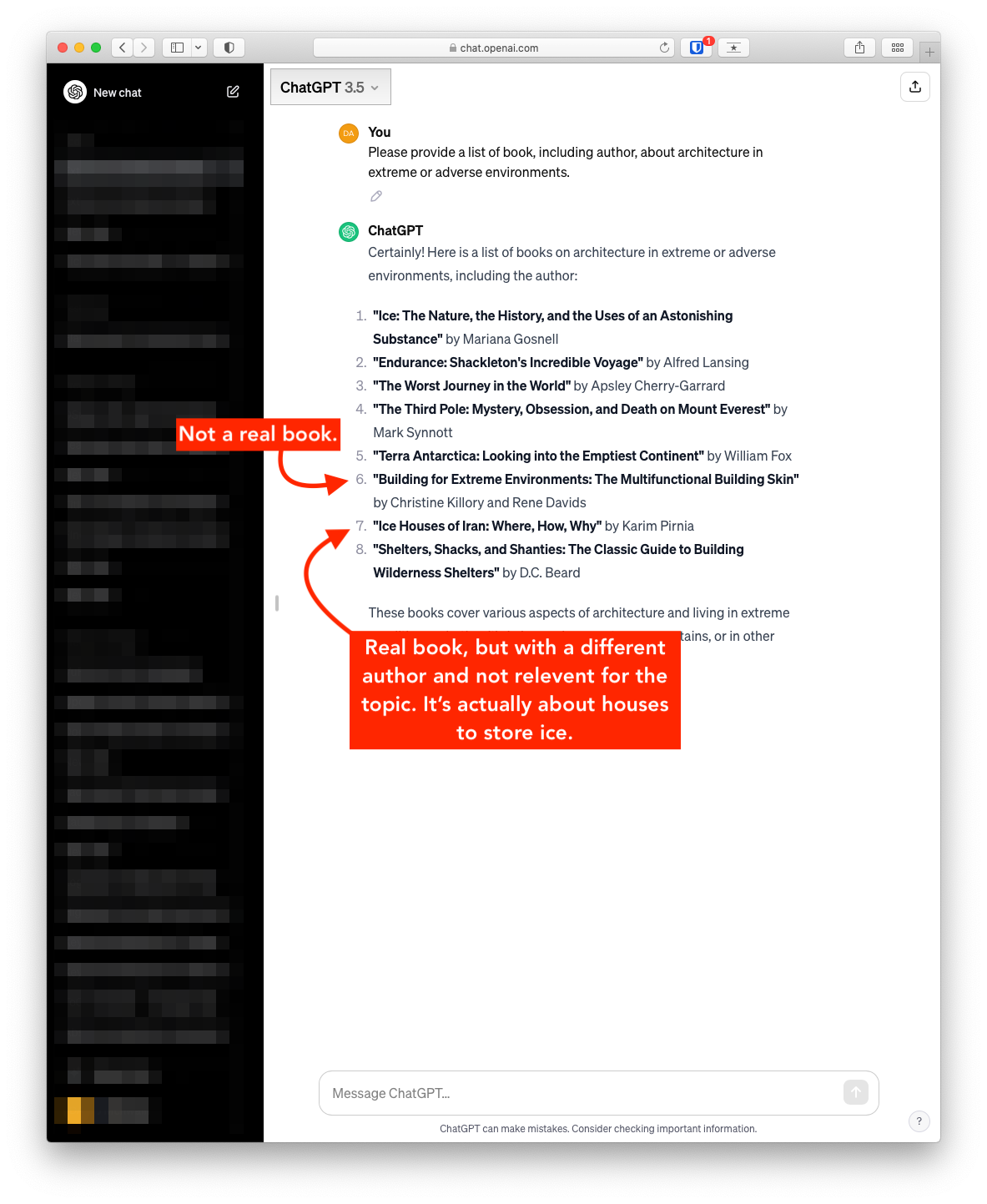
In the next below, ChatGPT was provided with the following prompt:
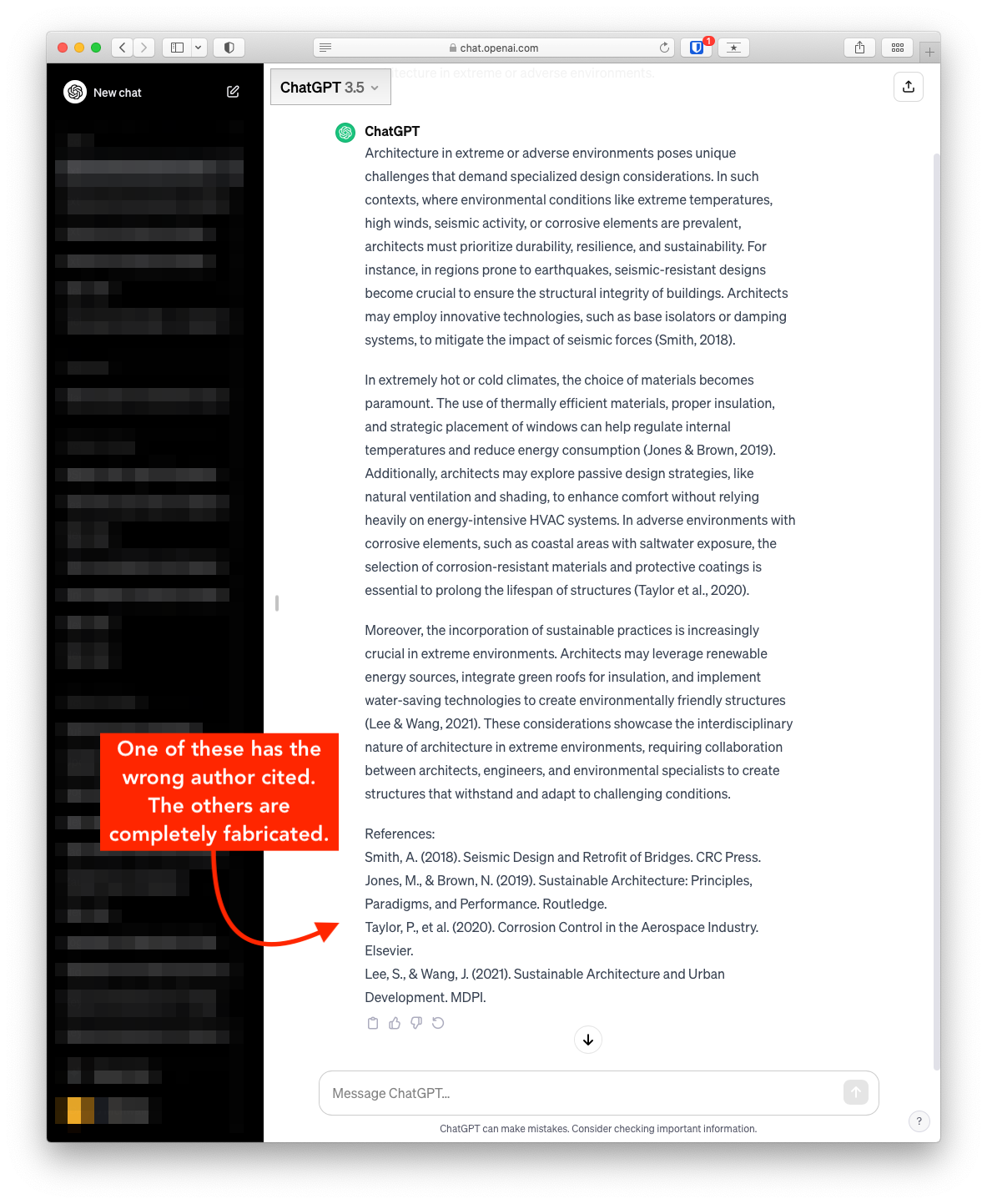
Please provide two to three paragraphs with in-text citations about architecture in extreme or adverse environments.
The only reference returned that appears to be real is the first, though the author seems to be incorrect. The others are not real.