



Synthesize and Report
Overview
Synthesis is where the work of the review becomes an argument. Having identified, screened, appraised, and extracted data from your included studies, you now interpret what they collectively say in response to your research question. Reporting then translates that interpretation into a structured written account that meets the standards of academic transparency required for a thesis.
These two activities, synthesis and reporting, are treated together here because they are iterative: the structure of your synthesis shapes the structure of your report, and drafting the report often reveals gaps in the synthesis that require you to return to your notes.
Choose Your Synthesis Approach
Your synthesis method was specified in your protocol. The two principal options for business and management SLRs are narrative synthesis and meta-analysis. A third option, thematic synthesis, is increasingly common and sits between the two.
Narrative Synthesis
Narrative synthesis organises findings from included studies into themes or categories and describes patterns, relationships, contradictions, and gaps in discursive prose. It is appropriate when:
- Included studies use different methodologies that cannot be statistically combined
- The evidence base is heterogeneous in population, context, or outcome measures
- Your research question asks "what," "how," or "why" rather than "how much"
This is the most common synthesis approach in business and management research and is suitable for the majority of thesis-level SLRs.
Thematic Synthesis
Thematic synthesis, developed by Thomas and Harden (2008), applies a more structured coding procedure to the findings of included studies before organising them into themes. It is particularly well-suited to reviews of qualitative studies and connects directly to the deductive, inductive, and combined coding approaches described in the Bandara et al. (2015) framework. The process involves three stages:
- Line-by-line coding of the findings and conclusions sections of each included study
- Developing descriptive themes by grouping related codes
- Generating analytical themes that go beyond description to interpret what the evidence means in relation to your research question
Meta-Analysis
Meta-analysis pools numerical results from multiple quantitative studies using statistical methods to produce an overall effect size estimate. It is only appropriate when:
- Included studies are sufficiently homogeneous in design, population, and outcome measure to be meaningfully combined
- A sufficient number of studies report compatible quantitative outcomes
- You have the statistical training to conduct and report the analysis correctly
Meta-analysis is rarely appropriate at thesis level in business and management research; if your supervisor has suggested it, seek guidance early on statistical software (R, Stata, or JASP) and reporting requirements.
Conducting Narrative or Thematic Synthesis
The following steps apply to both narrative and thematic synthesis.
Step 1: Familiarize Yourself with the Evidence Base
Before coding, read all your extraction notes as a whole. Review the memo you wrote at the end of Extract Data. Note the overall shape of the evidence: how many studies, what methods, what contexts, what time period.
Step 2: Develop a Coding Framework
Decide whether you will code deductively, inductively, or using a combined approach.
Deductive, Inductive, and Combined Coding
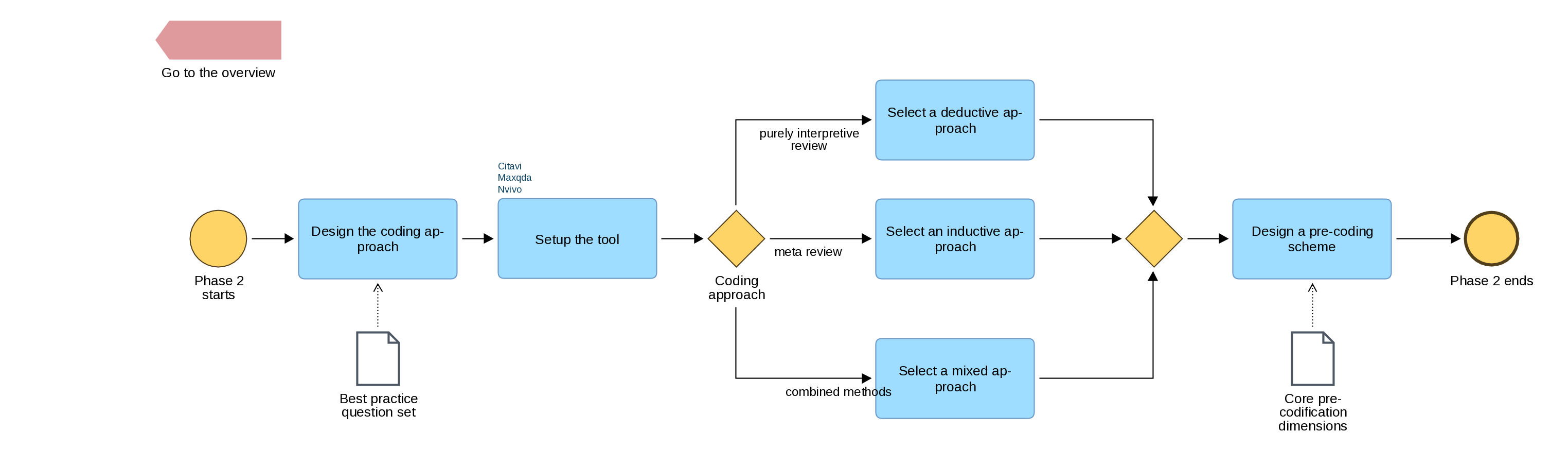
"Phase 2 of the Bandara et al. SLR process: organisation and preparation for analysis, including coding approach selection" by Hasan Koç is licensed under CC BY-NC-SA 4.0, based on Bandara et al., 2015.
The Bandara et al. (2015) framework, widely used in information systems and management SLRs, defines three approaches to coding:
Deductive coding: You bring a pre-existing theoretical framework or model to the data and apply its categories to the findings of included studies. This approach is appropriate when your research question asks how a specific theory has been applied across contexts, or when you are testing whether empirical evidence supports a theoretical proposition.
Inductive coding: Codes emerge from the data without a predetermined structure. You read findings across studies and assign descriptive labels that capture what is being said, allowing themes to develop organically. This approach is appropriate for exploratory research questions where the conceptual landscape is not yet well defined.
Combined approach: Begin with a small set of deductive codes derived from your research question or theoretical framework, then allow additional codes to emerge inductively as you encounter concepts not anticipated by the initial framework. This is the most flexible approach and is common in thesis-level SLRs where the scope is narrower than a full mapping review but broader than a theory-testing study.
For most business thesis SLRs, a combined approach is practical and defensible. Document your starting framework explicitly in your protocol and note any inductively derived codes as you develop them.
Step 3: Code the Findings
Work through your extraction form, reading the key findings field for each study and assigning one or more codes. Use a simple coding log: a spreadsheet or table with Study ID, finding, and code assigned. Keep codes concise (two to five words) and descriptive at this stage.
Step 4: Develop Themes
- Capture a meaningful pattern across multiple studies
- Be distinct from other themes (minimal overlap)
- Be grounded in the evidence (traceable back to specific studies)
- Be relevant to your research question
Aim for three to six themes for a typical thesis-level review. Fewer than three suggests over-aggregation; more than six suggests insufficient grouping.
Step 5: Interpret and Analyse
For each theme, write an analytical account that:
- Describes what the studies within the theme collectively show
- Notes the strength and consistency of the evidence (referencing quality appraisal ratings from Appraise Study Quality)
- Identifies contradictions between studies and offers an explanation if possible
- Notes where evidence is absent or weak
This is the intellectual contribution of your review. Do not simply list what each study found; explain what the body of evidence means.
Reporting Your Review
Your written report should follow the PRISMA 2020 reporting guidelines, which specify what information must be included and where. The standard structure for an SLR thesis chapter or standalone review paper maps onto the following sections.
Introduction
- Background and rationale for the review
- Research question, stated explicitly using your chosen framework (PICO, SPIDER, or PCC)
- Brief note on what the review contributes (addressing a gap, updating an earlier review, etc.)
Methods
The methods section must be detailed enough for the review to be replicated. Include:
- Protocol reference (PROSPERO registration number or statement that no registration was conducted and why)
- Eligibility criteria, stated in full
- All databases searched, with dates and full search strings
- Screening process: phases, tools used, number of screeners, inter-rater reliability statistic if applicable
- Quality appraisal tool(s) used, with citations
- Data extraction approach, with reference to the form (included as an appendix)
- Synthesis method, with justification
Results
Present results in three parts:
- PRISMA flow diagram: a visual account of records identified, screened, excluded at each phase, and finally included. The pre-formatted PRISMA 2020 Word template is available here.
- Characteristics of included studies: a summary table (one row per study) covering author, year, country, method, sample, and quality rating. This table belongs in the results section, not the appendix.
- Synthesis findings: your thematic or narrative synthesis, organised by theme, with in-text citations to included studies using your Study ID codes (e.g., S01, S07, S12).
Discussion
- Interpret your findings in relation to your research question
- Compare your findings with those of related reviews or foundational theoretical frameworks
- Discuss the quality of the evidence base honestly
- Identify gaps in the literature and propose directions for future research
- State the limitations of your own review (search coverage, solo screening, language restrictions, etc.)
Conclusion
A brief section (one to two paragraphs) stating the main answer to your research question and its implications for research or practice. Do not introduce new evidence here.
The PRISMA Flow Diagram
The PRISMA 2020 flow diagram is a mandatory element of any SLR report. It visually documents the flow of records through the review process and allows readers to evaluate the thoroughness of your search and the basis for your inclusions.
The four stages represented in the diagram are:
- Identification: total records retrieved from each database, plus any records from supplementary sources (grey literature, snowballing, hand-searching)
- Screening: records after deduplication; records excluded at title/abstract screening with reason counts
- Eligibility: full texts assessed; full texts excluded with reason counts; full texts not retrievable
- Included: final number of studies included in the review
A pre-formatted Word version of the PRISMA 2020 flow diagram is available here. Complete the numbers from your search logbook and screening tool records; do not estimate.
Presenting Included Studies
In-Text Citation Convention
During synthesis, refer to included studies by their Study ID (e.g., S01) rather than by author and year, to distinguish them visually from other literature cited in the discussion. Provide a complete reference list of included studies as a separate appendix, clearly labelled "Included Studies," so that examiners can locate them independently of your general reference list.
The Characteristics Table
The summary table of included study characteristics is one of the most-read elements of an SLR report. Present it clearly and completely. At minimum, include: Study ID, author(s), year, country, methodology, sample, and your quality rating. If space allows, add a brief "key finding" column (one sentence per study).
Common Mistakes to Avoid
- Synthesizing by summary. Listing what each study found, one by one, is not synthesis. Synthesis requires you to compare across studies, identify patterns, and draw analytical conclusions.
- Ignoring contradictory evidence. If two studies reach opposing conclusions, engage with both and attempt an explanation. Omitting contradictions is a form of bias.
- Detaching quality appraisal from synthesis. The confidence you express in your conclusions should reflect the quality of the underlying evidence. A finding supported only by weak studies should be qualified accordingly.
- Incomplete PRISMA numbers. Every number in the flow diagram must be traceable to your logbook. Inconsistencies between the diagram and the methods text undermine the credibility of the review.
-
Conflating limitations of included studies with limitations of your review. The limitations section of your discussion should address both, but separately: weaknesses in the evidence base are distinct from weaknesses in your review process.