



Research Process - Overview
It'sResearch is an iterative process of asking questions, finding information, refining your ideas, and contributing your own voice to an academic conversation. Whether you are writing a goodshort ideaessay or a final BA thesis, following these six steps will save you time, help you find better sources, and ensure you meet academic standards.
Note: Research is rarely a straight line. You will often need to keeprevisit detailedearlier research notes throughout the process. This can often save lots of time in the end. You may want to use a tool to manage your citations and save your sourcessteps as you research,learn Zoteromore about your topic.
Step 1: Define Your Research Question
Before you can search effectively, you need a clear focus. A strong research question is specific, debatable, and complex enough to require genuine investigation.
- Understand the scope: Review your assignment parameters, such as length, required source types, and deadlines. For a thesis, ensure your scope is feasible within your timeframe.
- Brainstorm: Start with broad topics that genuinely interest you and narrow them down.
- Use AI responsibly: Generative AI can be an excellent brainstorming partner to help you
donarrowthis.a broad topic into a specific question. Always verify the output and consult the library guidelines on Making the most of Generative AI (ChatGPT etc.).
Read more: How to Define a Research Question
Step 1:2: IdentifyGather Background Information
Do not dive straight into complex academic journals. Start by mapping the landscape of your topic
Read more
Some questions to get you started
With what topics are you already familiar?
In what topics do you have a genuine interest?
In what topics do you already have a strong opinion; positive or negative
Before diving into your topic, it might be helpful to understand key conceptsdebates, like research frameworksdefinitions, and methodologies. Learn more about What is a Research Framework? and What is Research Methodology? to guide your approach.
Still can't think of a topic?
vocabulary.Consider:
Brainstorming;Consultwritereferencedownsources:any ideas that come to mindTalking with lecturersTalking with classmatesConsulting sources like general andUse subjectspecific encyclopaedias (ahem,Wikipedia),encyclopaedias, handbooks, andtextbooksglossaries to grasp the fundamental concepts.- Harvest keywords: Note the specific terminology, theories, and key authors mentioned in your background reading. You will need these for
ideasyour literature search. BrowsingRefinerecentyourissuesfocus:ofIfperiodicalsyouforfindcurrenttooissuesmuch information, you may need to narrow your question; if you find too little, you may need to broaden it.
Read Wikipedia:Gathering TheBackground GoodInformation
Step 3: Develop a Search Strategy and theFind Not So GoodSources
WikipediaAcademic issearching requires different tools and techniques than a greatstandard placeweb tosearch. startA yoursystematic research,approach butensures you do not amiss greatcritical place to end it.
Strengths of Wikipedialiterature.
- Build a search string: Combine your keywords using Boolean operators (AND, OR, NOT) to focus your results.
- Choose the right tools: Decide when to use the library catalogue (OPAC) for books, versus specialised databases (like EBSCO or JSTOR) for peer-reviewed journal articles.
- Search iteratively: Run a search, review the results, adjust your keywords, and search again.
WikipediaRead more: Developing a search strategy
Step 4: Evaluate Your Sources
Not all information is updatedequal. frequently.You Newmust informationcritically canassess be,every andsource oftenbefore is, addeddeciding to use it in your academic work, especially for a thesis.
Weaknesses of Wikipedia
Editors on Wikipedia are not necessarily experts. Authorship on Wikipedia is often anonymous or obscured.Articles are always changing, making them difficult to cite in your research. An article you read today, may look quite different tomorrow.Articles can be vandalised, providing wildly inaccurate information.
Review your assignment
Before you begin, make sure you understand your assignment and its requirements.
Consider:
Length; How many words are required?Date Due; When isCheck thepaper due?Additional requirements; Are there any specific requirements for the assignment?
Step 2: Find background informationevidence:
Read more
Use your textbook, class notes, reference books, Wikipedia, and/or a broad Google search to find information about the events, places, people and jargon associated with your topic.
Identify keywords related to your topic.Search encyclopaedia and other general sources.Collect additional keywords that you can use to search later.
Wikipedia
{{@2#bkmrk-wikipedia%3A-the-good-}}
Step 3: Sources
Step 3.1: Search for your sources
Read more
See Where to find sources and How to search
Think of it like a healthy diet. You want a variety of high quality sources going into your research.
Store your sources in Zotero as you go. This will save you a lot of time and help prevent accidental plagiarism.
Step 3.2: Evaluate what you’ve found
Read more
Once you have a variety of sources (or as you're collecting them), it's time to evaluate them. There are several models and checklists for guiding researchers through the evaluation process, but all are asking the same questions.
ABC Checklist
Accuracy: Is the informationpublication correctpeer-reviewed? and current?
When wasDoes theinformationauthorpublishedciteortheirposted?sources clearly?HasIdentifythebias:information been revised or updated?Does your topic require current information, or will older sources work?If it's an online source, are the links working and up-to-date?
Bias: Is the information fair and objective?
- What is the purpose of the
information?publication,Isanditwhat perspectives might be missing? - Apply a framework: Use established methods like the CRAAP test or the SIFT method to
inform,evaluatetotextsteach, to sell, to entertain? Do the authors or sponsors make their intention or purpose clear?Is the information fact, opinion, or propaganda?Does the point of view appear objective and impartial?
Credibility: Is this source believable and trustworthy?
Who is the author, publisher, source, or sponsor?What are the author's credentials or organisational affiliations?Is the author qualified to write on the topic?Is there contact information such as a publisher or e-mail address?What kind of reputation does the author, publisher, or website have? Search the Internet to see what other credible sources have to say about the resource that you are evaluating.systematically.
IfRead more: How to evaluate academic sources
Step 5: Read, Manage, and Synthesize
Once you can'thave findyour ansources, authoryou orneed organisationto listed,extract especiallythe onrelevant information and organise it so you can build your own argument.
- Read strategically: Read the abstract, introduction, and conclusion first to determine if a
website,paperyouisshouldhighlymove on and look for another source.This diagram illustrates the concept ofauthority, placing a number of sources on the spectrum from popularrelevant toscholarly.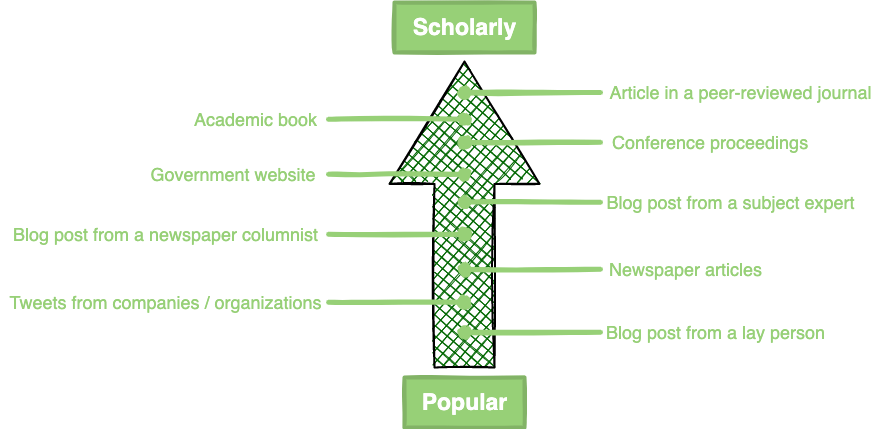
Adapted fromMy Learning Essentialsresources developed by the University of Manchester Library and licensed underCC BY-NC 3.0.
Step 3.3: Make notes
Read more
While doing your research you will be making connections and synthesizing what you are learning. Some people find it useful to make "idea cards" or notes in which they write out the ideas and perceptions they are developing about their topic.
How to Work with Notes
After you take notes, re-read them.question.ThenTakereorganisethematicthemnotes:by putting similar information together. Working with your notes involves re-grouping them by topic instead of by source. Re-groupGroup your notes byre-shufflingtheme or concept rather than just by source. This makes it easier to write a coherent literature review.- Manage your
indexdata:cardsUseorcitation management software to save PDFs, organise notes, and generate bibliographies automatically. - Structure your argument: Outline your introduction, body paragraphs (supported by
color-codingevidence),orandusingconclusion. - Integrate sources: Use direct quotes sparingly. Prefer paraphrasing to
code notes in a notebook. Review the topics of your newly-grouped notes. If the topics do not answer your research question or support your working thesis directly, you may need to do additional research or re-think your original research.During this process you may finddemonstrate that youhavefullytaken notes that do not answer your research question or support your working thesis directly. Don't be afraid to throw them away.
Tip: The library strongly recommends using Zotero to manage your sources. See our guide on Citation Management Software.
Read more: Read, Manage, and Synthesize
Step 6: Write and Cite
Writing is how you enter the academic conversation. It requires integrating your sources accurately, ethically, and persuasively.
It may have struck you that you just read a lot of "re" words: re-read, reorganise, re-group, re-shuffle, re-think. That's right; working with your notes essentially means going back and reviewing how this "new" information fits with your own thoughts aboutunderstand the topic or issue of the research.
Grouping your notes should enable you to outline the major sections and then the paragraphs of your research paper.
Step 4 (if applicable): Compilation / Evaluation of Original Data
Read more
For some research projects, you may have data that you have collected. Now is the time to compile and evaluate that data.
Step 5: Write your paper
Read more
Writing your paper is where you bring together all the research, analysis, and planning you've done so far. This step involves narrowing your topic into a focused research question, structuring your argument, integrating evidence effectively, and ensuring clarity and flow in your writing.
Additional Tips for Writing Success
Start early—writing takes time to revise and refine.Break down writing into manageable tasks (e.g., draft one section at a time).Read aloud—this helps identify awkward phrasing or errors in flow.Seek feedback—ask peers or instructors to review drafts for clarity and coherence.
By following these steps, you can craft a well-organized paper that effectively communicates your research findings and arguments.
Step 5.1: Narrow Your Topic into a Research Question
Read more
Refine your original topic into a clear, specific research question or thesis statement.Consider:Is the research question feasible within the available timeframe and resources?Is the question too broad or too narrow? Strike a balance to ensure depth without overwhelming scope.
A well-crafted research question or thesis will guide the direction of your paper and help you stay focused.
Step 5.2: Structure Your Paper
Read more
A strong structure is essential for presenting your argument logically and persuasively. Most academic papers follow this general structure:
Introduction
Introduce the topic and explain why it is important (exigence).Provide necessary background information to contextualize your research.Present your thesis statement—a concise summary of your main argument or research focus.
Body Paragraphs
Divide the body into logical paragraphs, each focusing on one central idea.Start each paragraph with a clear topic sentence that introduces its theme.Develop the paragraph with evidence (e.g., data, quotes, examples) and explain how it supports your thesis.Use transitions to maintain logical flow between paragraphs and sections.Address counterarguments where relevant, demonstrating why they do not undermine your thesis.
Conclusion
Summarize your main points and restate the significance of your argument.Revisit your thesis in light of the evidence provided but avoid introducing new information.Optionally, suggest areas for future research or implications of your findings.
Step 5.3: Integrate Sources Effectively
Read more
Research writing is a conversation between your ideas and those of others. Use sources to support, challenge, or contextualize your arguments while maintaining your own voice.
Introduce: Briefly describe the source (e.g., author credentials, title) to provide context for its relevance.Integrate: Use direct quotes, paraphrases, or summaries as appropriate:Quotationsemphasize credibility by using an author’s exact words.Paraphrasinghighlights specific points in your own words.Summarizingcondenses larger ideas into brief overviews.
Connect: Explain how the source supports or relates to your argument.material.- Cite correctly:
:Give proper credit to authors usingApply the required citation style(e.g.,APA for FoB,Chicago for FoAD).
Step 5.4: Maintain Clarity and Flow
Read more
Effective academic writing is clear, concise, and logically organized:
Signposting: Use words like "however," "therefore," "in contrast," or "moreover" to guide readers through transitions in ideas.Consistency: Stick with consistent terminology for key concepts throughout the paperto avoidconfusion.Simplicity: Avoid overly complex sentences or jargon unless necessary; aim for precisionplagiarism andreadability.give
Step 5.5: Cite Your Sources (as You Write)
Read more
Proper citation ensures you giveproper credit to authorsoriginal whose work you reference:
Citation is a cornerstone of scholarly communication and adds credibility to your work.Use citation management tools like Zotero to organize references and generate bibliographies efficiently.authors.
ForFaculty moreRequirements: informationThe aboutFaculty citingof Business (FoB) uses APA style. The Faculty of Architecture and citations,Design see(FoAD) ouruses guideChicago on the topic.style.
PleaseRead note:more: FoB uses APA-style citationsWrite and FoAD uses Chicago-style citations.
Citing as you write saves a lot of time in the end! It is recommended to use Citation Management Software such as Zotero to store your sources and generate bibliographies.
Step 6: Proofread
Read more
The importance of proofreading cannot be understated.
Strategies to Help Identify Errors
Work from a printout, not a computer screen. Besides sparing your eyes from the strain of glaring at a computer screen, proofreading from a printout allows you to easily skip around to where errors might have been repeated throughout the paper [e.g., misspelled name of a person].Read out loud. This is especially helpful for spotting run-on sentences and missing words, but you'll also hear other problems that you may not have identified while reading the text out loud. This will also help you adopt the role of the reader, thereby, helping you to understand the paper as your audience might.Use a ruler or blank sheet of paper to cover up the lines below the one you're reading. This technique keeps you from skipping over possible mistakes and allows you to deliberately pace yourself as you read through your paper.Circle or highlight every punctuation mark in your paper. This forces you to pay attention to each mark you used and to question its purpose in each sentence or paragraph. This is a particularly helpful strategy if you tend to misuse or overuse a punctuation mark, such as a comma or semi-colon.Use the search function of the computer to find mistakes. Using the search [find] feature of your word processor can help identify repeated errors faster. For example, if you overuse a phrase or use the same qualifier over and over again, you can do a search for those words or phrases and in each instance make a decision about whether to remove it or use a synonym.If you tend to make many mistakes, check separately for each kind of error, moving from the most to the least important, and following whatever technique works best for you to identify that kind of mistake. For instance, read through once [backwards, sentence by sentence] to check for fragments; read through again [forward] to be sure subjects and verbs agree, and again [perhaps using a computer search for "this," "it," and "they"] to trace pronouns to antecedents.End with using a computer spell checker or reading backwards word by word. Remember that a spell checker won't catch mistakes with homonyms [e.g., "they're," "their," "there"] or certain word-to-word typos [like typing "he" when you meant to write "the"]. The spell-checker function is not a substitute for carefully reviewing the text for errors.Leave yourself enough time. Since many errors are made and overlooked by speeding through writing and proofreading, setting aside the time to carefully review your writing will help you identify errors you might otherwise miss. Always read through your writing slowly. If you read through the paper at a normal speed, you won't give your eyes sufficient time to spot errors.Ask a friend to read your paper. Offer to proofread a friend's paper if they will review yours. Having another set of eyes look over your writing will often spot errors that you would have otherwise missed.